This isn’t the story I had planned to post next, but I can’t help myself!
I knew that my great-great-grandfather, Fielder Montgomery Magruder, registered for the draft in Washington, D.C, in 1863 but never served–and that’s all I knew. Was he ever drafted? If he was, he must have procured or paid for a substitute, like his distant cousin Caleb Clarke Magruder Jr., who appears in Post #1 in this series. I didn’t know how to find out.
A few days ago, a full-text search on FamilySearch.org turned up a small batch of random records for Fielder, including the Certificate of a Substitute for Robert Johnson, of Virginia, who served in his place.
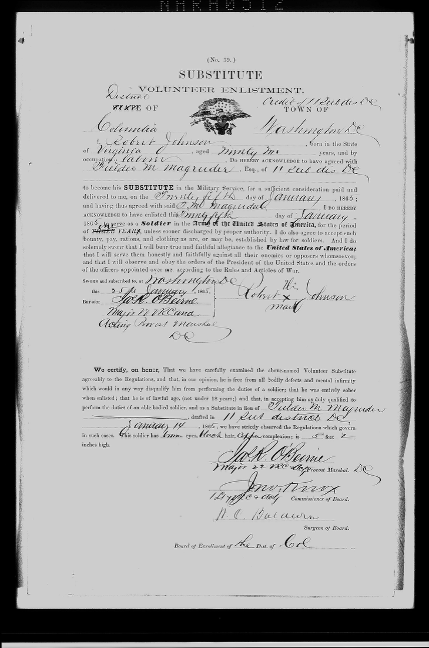
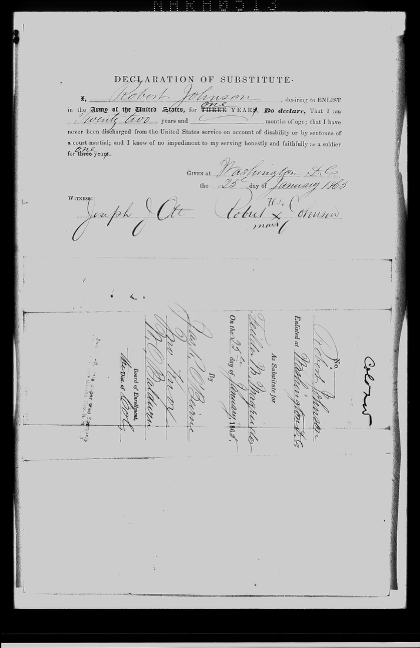
As you can see, as of 25 January 1865, Robert Johnson was twenty-two years old, five-foot-two, with skin color described as copper. African Americans (and, often, working-class whites) were routinely described as laborers, so that term doesn’t necessarily mean that Robert had no skills. Whether he was born free or had been formerly enslaved was not recorded: by 1865 in D.C. or Virginia, that question was officially moot.
At the top left of the first page you can see that his enlistment, in Washington, D.C., counted toward the draft quota of the recruiting district (sub district 11) where F.M. Magruder lived. The lower section of that page informs us that Fielder had been drafted just eleven days earlier, on 14 January.
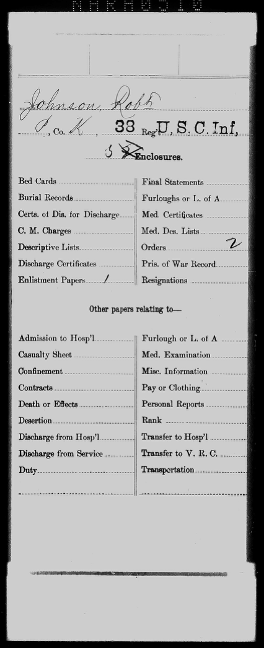
This certificate is part of Johnson’s military record, now collected by the National Archives into what’s known as a Consolidated Military Service Record (CMSR). Elsewhere in his CMSR I learned that, even though he enlisted in Washington, Johnson was recruited at a recruitment depot “in the field” in Virginia. I can imagine various scenarios that brought these two men together–in life or merely in the paperwork–but so far I have no clues. You may also notice that the form calls for the standard three-year enlistment but Robert was enrolled for just one.
By March first, Johnson had been assigned to Company K of the 38th U.S. Colored Infantry. The 38th had been formed about a year before he enlisted and in 1864 had seen some hard fighting. Three men from the regiment received the Medal of Honor for their part in the Battle of Chaffin Farm, fought on the periphery of Richmond in September 1864.
Just weeks after Robert Johnson joined Company K, Richmond fell and Ulysses S. Grant accepted the surrender of Robert E. Lee and the Army of Northern Virginia at Appomattox Courthouse. In May, the 38th was transferred to Texas, where Confederate resistance lingered on. Soldiers who joined late in the war–and therefore still had a lot of time to serve–were prominent among those sent to Texas, and that included many of the USCT regiments.
But Robert Johnson was a lucky guy. Not only did he have a short enlistment, but immediately upon enrollment–on March 17 to be precise–he was detached from his company and assigned to duty in the Division Quartermaster Department. There he served until discharged, exactly one year after his enlistment. His Detachment Muster-out Roll summarizes his service and the last card, nearly blank, shows his easy passage through the tail-end of the war–never a casualty, never hospitalized, never deserted, never court-martialed or confined for disciplinary reasons. Whatever his sufferings or privations–and there must have been some–they fell into none of the army’s categories.
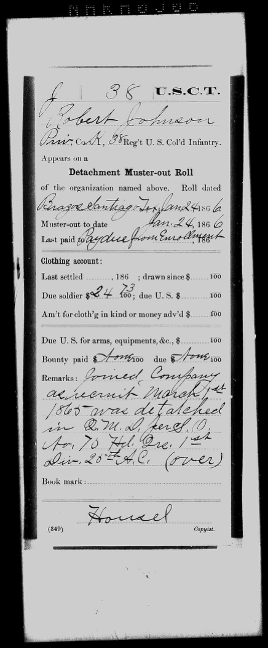
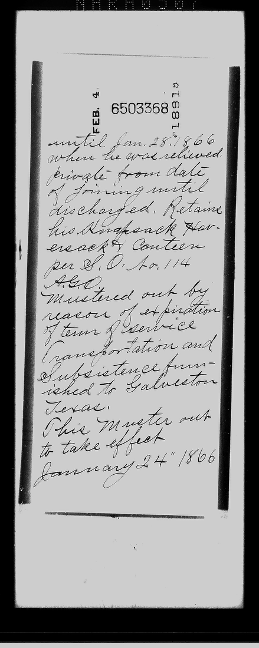
Leaving (per orders) with his knapsack, haversack, and canteen, and with $24.73 in his pocket, Johnson was provided with subsistence and transportation as far as Galveston. Where he went from there is an open question. Historians estimate that around a quarter of the first-generation “cowboys” of later fame were black, and some of those were USCT soldiers discharged in Texas. Was Robert Johnson one of them? Or did he head straight back to Virginia or D.C., to rejoin his family or find his sweetheart?
One more mystery. His discharge record states that he was paid no bounty–none paid, none due. If I ever find my way into that story–or other questions brought up by these records–I’ll post a follow-up.
________________________________________________________________
Compiled Military Service Records of Volunteer Union Soldiers Who Served with the United States Colored Troops: Infantry Organizations, 36th through 40th, Robert Johnson. NARA Microfilm Publications, M1993, Washington DC, 2006. Family Search, US Military Records 2006, image 51 (https://www.familysearch.org/ark:/61903/3:1:3QHV-L3J9-XXB5?view=fullText&lang=en&groupId=).
 Magruder's Landing