I’ve just discovered this beautiful site by Andy Sweet. Back in 2006 he posted Ancient Sites in Glorious Sunshine, a photo essay of his trek around Perthshire, in which he climbed up to the complex of standing stones above Craigneich Farm. One stone stands near the road and is visible even to the most casual visitor, but that is just the beginning…
Author Archives: susantichy
Are you an American McGruther or McGruder who is not descended from Alexander Magruder?
If you have been trying in vain to figure out how you are descended from Alexander Magruder, take heed!
It has long been believed that every Magruder and McGruder in America is descended from Alexander Magruder, who was brought to Maryland as a prisoner of war in the 1650s. I recently learned from Don McGruther in Scotland that other families came to the U.S. during later waves of immigration. Some of those families arrived via Ireland and their descendants today may think of themselves as Irish American.
Don would like to find any McGruthers, McGruders–or those with other versions of the family name, such as McGrew, McCrew, or McCrue–who came separately to North America. He has compiled extensive information from public records and may be able to help you trace your Scottish ancestors. If you are interested in having your DNA analyzed, it may also be possible to establish how closely you are related to Don’s line, to the Alexander Magruder line, or to others, even without a paper trail.
The spelling of your name might be a clue. In Scotland the name was spelled variously, with McGruther, McGruder, McGrudir, and McGrouther among the most common. Magruder is a uniquely American spelling, adopted from the signature on Alexander’s 1677 will. If your family arrived later, it’s most likely you are using one of the Scottish spellings–or perhaps a different spelling altogether. A few of Alexander’s descendants do use one of the Scottish versions of the name, so to find your line of descent you’ll need more clues than just the spelling…but it is one place to start.
If you know or believe you might be descended from later immigrants, please get in touch. You can write to Don at mcgruther(at)btopenworld.com, or contact me via the Contact tab at the top of this page.
Don’t be a stranger!
African-American Magruders in Washington DC Slavery Petitions, 1862
I’ve just published a page on Af-Am Magruders Named in Washington DC Slavery Petitions, 1862.
All those enslaved in the District of Columbia were emancipated by the Compensated Emancipation Act of 16 April 1862. Slaves were freed immediately and slave holders had 90 days to file a petition for compensation. Though the 3,100 slaves emancipated comprised less than 1% of enslaved people in the U.S., its ultimate impact was far greater, providing a legal framework and precedent on which the Emancipation Proclamation was modeled.
The website Civil War Washington has transcribed and indexed those petitions, with images of the original documents attached–an outstanding resource for any African-American searching for ancestors in the city. Because both owners and the enslaved frequently moved back and forth across city limits, this source also should be searched for those with Maryland or Virginia roots. Most former slaves left their owners immediately and by 1870 70% of the approximately 3,100 emancipated people had left the city. So even if your family has no known connection to DC, you should take a few minutes and search these petitions. The site is well designed and both quick and easy to use.
As always, the best sources for details about enslaved people are those created at moments when it was in the slave owner’s interest to provide a full name and a full description. In this case, owners had to present their slaves for examination, or, if a person had run away, produce witnesses who could testify to the slave’s condition and value. Petitions provide surnames, physical descriptions, and, in many cases, details about the enslaved person’s skills, living situation, and family members. Petitioners also had to say how and from whom they acquired each person–more priceless detail for genealogists.
More than 150 slave holders failed to file a petition. To receive compensation, each had to swear (among other things) loyalty to the Union; so most of those who failed to file are assumed to have been Southern supporters or known sympathizers. Others were residents of Maryland or Virginia, whose slaves had been living–perhaps hired out, perhaps fugitive–in the District. On 12 June 1862 Congress passed a supplemental act allowing slaves whose owners had failed to petition to file petitions for their own freedom. Each of these supplemental petitions includes the individual’s request for freedom plus the testimony of witnesses who could verify ownership, residence in the District, and other details. These “supplemental petitions” were the first instance in which slaves were allowed to petition and give testimony in a Federal court, another legal precedent with far-reaching consequences.
On my page, I list the African-American Magruders I found named in the petitions, with a few notes on their circumstances and possible connections to other families or individuals.
Bernice Bennett’s Geneaology Blog Talk Radio
Yesterday I met an extraordinary woman, Bernice Alexander Bennett, and discovered her Thursday evening Blog Talk Radio program, “Researching at the National Archives & Beyond.” Bernice’s guests are authors and researchers with wide experience. Topics among recent programs include searching incarceration records, genealogy resources in Louisiana, and Freedmen’s Bureau records. Last week’s show, Dr. Maurice Gleeson on “The Irish in the Slave Trade,” addresses both Irish men sent as bound labor to the West Indies and American colonies and Ireland’s participation in the African slave trade, and also debunks a few unfounded beliefs about these histories.
All shows are broadcast live, including call-in and write-in questions and comments from listeners, and all shows are archived–174, so far. Sound quality is not like commercial or public radio, but it’s fairly good. Broadcast is Thursday evening, 9:00 p.m. Eastern Time…and one upcoming program features Edward E. Baptist, whose book The Half Has Never Been Told: Slavery and the Making of American Capitalism I am reading now and highly recommend. From now on, you’ll find a link to this program in my blogroll, listed as Bernice Bennett: Genealogy Live Talk Radio.
Legacy of Slavery in Maryland: Searchable Database of 300,000 names
The Maryland State Archives Online is constantly changing, which can be confusing for users but more often presents new opportunities for research without leaving home. Today I want to draw your attention to the Legacy of Slavery in Maryland database. Now expanded and easier to use, this database includes more than 300,000 names of people both black and white. It searches Census records from 1776-1880, and 26 additional categories of records, including runaway ads, chattel records (sales of slaves), manumissions, slave jails, accommodations docket (fees for housing runaways), and assessment records (assessments of slaves in estate inventories). Most of the records are from 1830-1880. The database provides basic information, sometimes a description of the person, the name of the owner, and a full citation to the Maryland State Archives (MSA) Record Series from which the information has been transcribed.
Runaway ads can be extremely important sources of information. Slaveholders provide the most complete information about a slave when in it is their interest to do so, so the ads often include personal characteristics and skills, as well as full name, appearance, height, and distinguishing marks. They also include speculation about where the runaway might be headed, and most often that is back to where they came from or where they have family members. Browsing the ads for runaways from Magruder plantations, I’ve learned that one man likes to dress well; that another is a good carpenter; that a woman is an excellent cook; that another woman talks too much; that another man had been free to hire himself out in Washington City, but had recently disappeared, probably headed for Baltimore and then to Pennsylvania and freedom.
Good luck in your search.
Another resource: “Our Black Ancestry” networking site
Through fellow members of Coming to the Table, I recently learned of Our Black Ancestry, a site that includes an interactive data base for people researching various African-American surnames. Just click on the Surnames tab at the top to reach directions for how to use the site. Also recommended: post your inquiries on a RootsWeb forum for the county where your ancestors lived. CTTT’s home page reads:
Coming to the Table provides leadership, resources and a supportive environment for all who wish to acknowledge and heal wounds from racism that is rooted in the United States’ history of slavery.
New regional chapters are forming, and a national gathering takes place every year. Assistance can include mentoring and support for descendants of the enslaved and descendants of enslavers who are searching for linked ancestors. For those who can’t travel to a meeting, monthly conference calls on a variety of subjects can help connect you to this community.
Priscilla Gray & Her Descendants, in bondage to Maryland Magruders for 150 years
For at least a year I have been promising to compose a page about Priscilla Gray and her descendants. Priscilla was a mulatta “born of a white woman,” indentured as a servant to Sarah Magruder, widow of Samuel Magruder (d. 1711). Technically, Priscilla was a free woman, because her mother was a free white woman, but long periods of indenture imposed on both mothers and their illegitimate children kept women like Priscilla in virtual slavery for years, sometimes for life.
In 1727 Priscilla was convicted for the same crime her mother had committed–bearing an illegitimate mixed-race child–and sentenced to seven additional years of servitude to Sarah Magruder. Her child was sentenced to 31 years of servitude. It was rare in Prince George’s County, in those years, for a woman to be prosecuted more than once for the crime of “mulatto bastardy.” Priscilla, her daughters, and other women held in bondage by the Magruders and families with whom they intermarried seem to have comprised a majority of the repeat offenders. In all, Priscilla bore seven children and served an additional 35 years of bondage for the “crime” of childbirth. Her daughters–each of whom was held in servitude to the age of 31–suffered the same fate, their terms of service extended with the birth of each child. Some of Priscilla’s daughters and other descendants did manage to survive long enough to obtain their freedom; others not. Slaves named Gray were named and manumitted in Magruder wills right up to 1860, the eve of Emancipation.
There are many gaps in my information on the Gray family. I hope in future to fill some of those gaps; but for now, here is what we know about Priscilla Gray and her legacy. If you are an African American descended from Priscilla, please get in touch, and teach me more about your family’s story.
New gateway page to the McGruther/Magruder heartland
Hi friends. It’s been a long time since I updated the site, and for that I apologize. I have had some messaging back and forth with a few of you, though, so Magruder-land was never far from my thoughts. In fact, I spent a week in Perthshire in June, where I had the great pleasure of meeting both Don McGruther and Hugh and Margie Rose. Hugh and Margie very kindly hosted myself and a friend at Trian House for lunch, before Hugh took us for a tour around Glen Artney and nearby sites. His knowledge of Drummond history was a plus for me. The next day Don drove up from his home near Glasgow to answer some of my McGruther history questions and to drive us around to some sites I’d not seen on earlier visits, including Drummond Castle Gardens and the Drummond chapel at Innerpeffray Library.
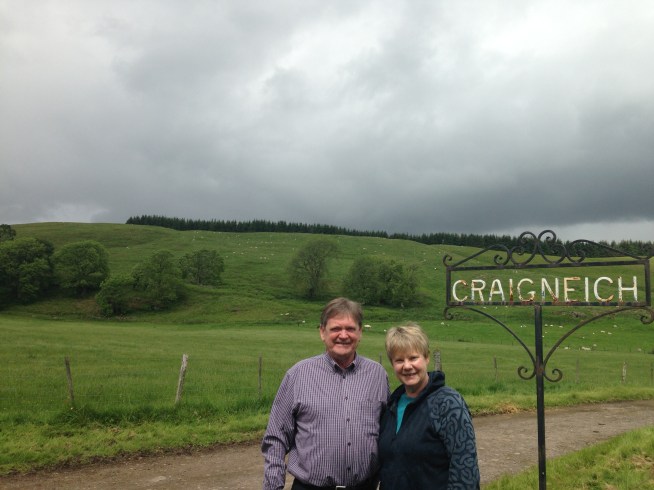
With Don McGruther, under a stormy sky at Craigneich. Photo: Brandon Moore-McNew, June 2014.
While in Perthshire, we were fortunate to stay at The Arch House, headquarters of Grace Notes Scotland, a nonprofit founded by Margaret Bennett to conserve and pass on the traditional cultures of Scotland, both Gaelic and Scots. The Arch House occupies part of what once was the stable block at Dunira Estate, west of Comrie–a unique and beautiful place.

The Arch House, Dunira Estate, Perthshire. Photo Susan Tichy, June 2014.
When I got home I had good intentions about getting right to work on this site…but instead spent the rest of the summer in a place with limited access to the internet–yes, there still are such places–so I’m just now trying to catch up.
So today I’ve made a new gateway page to the McGruther/Magruder Heartland, and made updated pages about sites in Glen Artney, Directions to Belliclone, etc., outgrowths of that page. Hugh Rose’s beautiful photos are also now part of that family of pages. My own photos will be coming soon. The gateway page includes a historical summary, so you can figure out where you want to visit and why.
Maybe all you need to know is how beautiful it is in June…

Glen Artney from Hugh & Margie’s garden, Trian House. Photo: Susan Tichy, June 2014.
A twilight visit to Godiah Spray plantation, St. Mary’s City
The day was waning by the time we got to Historic St. Mary City’s replica of a typical prosperous 17th c. plantation, but we made the best use we could of the remaining light. Enjoy! Godiah Spray
A visit to Historic St. Mary’s City, Maryland
Finally (!) I have finished and published a page about St. Mary’s City & the Founding of Maryland. Undoubtedly, it will be corrected and expanded as time goes on, but here’s a chance for a virtual visit. Many thanks to my friend Peggy Yocom for her beautiful photographs.
Still to come: a page on the Godiah Spray Plantation, replica of a typical 17th c Maryland plantation. (Forget Gone with the Wind–it’s more like Daniel Boone.)
 Magruder's Landing